SEO guide: These days, search engines are the greatest resource for finding goods, services, businesses,
or answers to queries. If search engines are unable to locate your website, you are not making
the most of it and are losing clients.
Search Engine Optimization (SEO) is crucial because of
this. By making it easier and faster for search engines to find your website and direct readers
to your page, SEO improves a website’s visibility. Whether you are a student, a blogger, a
business owner or you are thinking about a career, in marketing understanding SEO guide is very
important.
In this guide I will explain the fundamentals of SEO how SEO works, key SEO strategies,
keyword research how to optimize content the role of backlinks, technical SEO aspects and
how to evaluate SEO performance. How long SEO takes to show results ?
What Is SEO?
SEO stands for Search Engine Optimization. SEO refers to the means and methods of
optimizing a website or its contents; in other words, optimizing relative to the search engine.
For example, let’s imagine a digital marketing agency based in Kerala. The potential client
would most likely search in the search engine “digital marketing services in Kerala” – and if
the website of this agency is properly optimized, it will appear in the search results.
Moreover, it is crucial not to stuff the text with keywords since the modern search engine
algorithms are already pretty good at understanding what the page is about.
This is why good SEO guide is about creating quality content, a quality layout of the site, its easy
navigation, and building authority and trust.
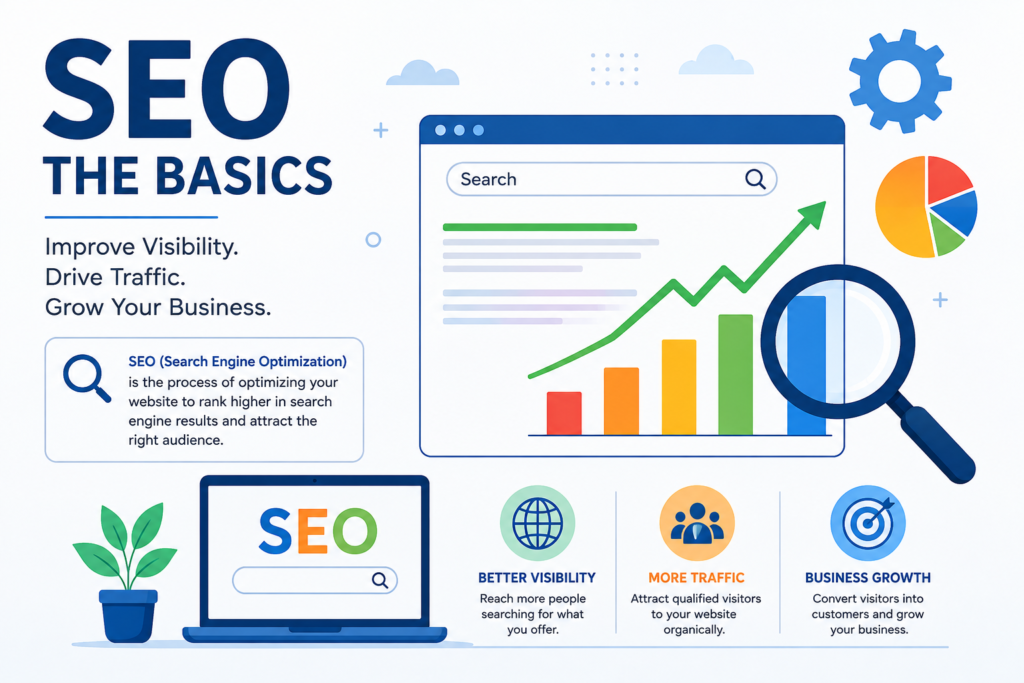
Table of Contents
How Do Search Engines Work?
Before proceeding to learn SEO techniques, one must acquaint himself with the working
mechanism of search engines.
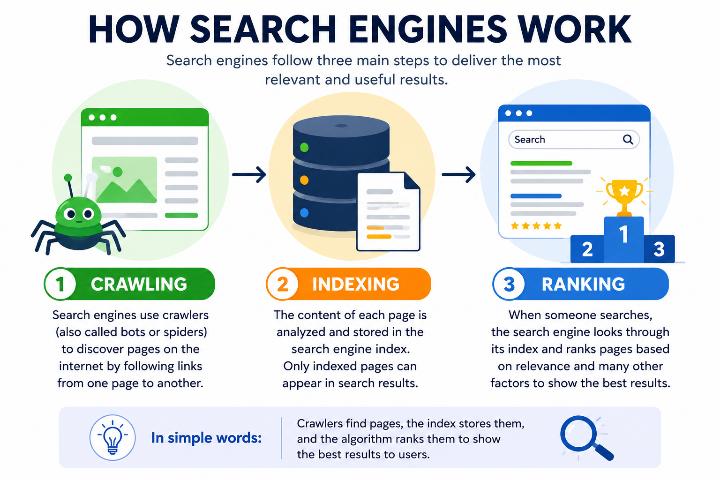
First of all, search engines operate via three basic processes: crawling, indexing, and ranking.
- Crawling refers to the process when search engines scan web pages by following links from
one site to another. - Further, those sites which are found to be relevant are indexed in the search engine’s huge
database. - Finally, upon receiving a query from a user, search engines scan their index in accordance.
with the search terms and yield the most appropriate results ranked based on multiple
criteria.
Once the basic idea of search engines is grasped, it becomes comprehensible why SEO guide
practices are of prime importance.
Why Is SEO Important?
By focusing on those who are already considering purchasing similar products or services,
SEO may help any business draw in customers.
Organic traffic is the biggest benefit of SEO. In other words, individuals use search engines to
find a company’s website, and the business does not have to pay more for each visitor.
Additionally, SEO guide can assist:
- Boost visibility
- generate natural traffic
- increase brand recognition
- improve the user experience
- Acquire leads or sales
- develop authority
- create a long-lasting internet presence
It should be remembered, nevertheless, that SEO is a long-term marketing endeavor. To put it
another way, it can take some time to observe any results.
The Main Types of SEO
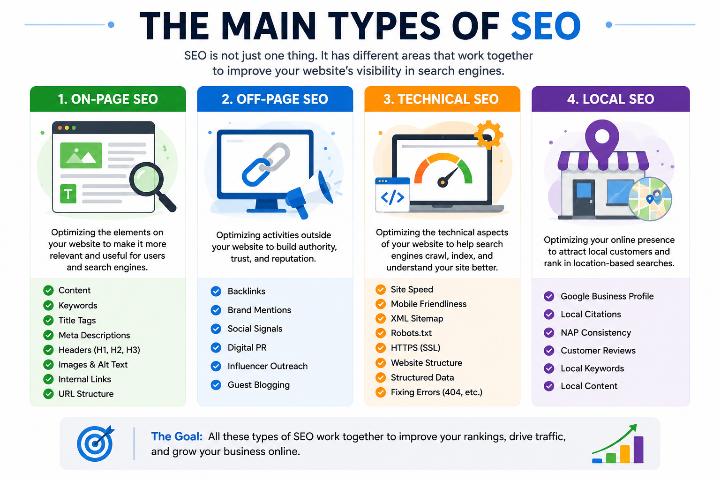
SEO could be broadly classified into a few categories. The first four are the on-page SEO , offpage SEO , technical SEO , and local SEO. These are the major types of SEO guide that one should
be familiar with.
On-Page SEO
This is the type of SEO that deals with optimizing the elements on ones web page. It entails
optimizing the following;
- Titles
- Headings
- Content
- Keywords
- Description
- URLs
- Images including their descriptions
- Internal linking
The main aim of on-page SEO is to ensure that the web page is informative and optimized to
both its visitors and the search engines.
Off-Page SEO
Unlike on-page SEO, the off-page deals with optimizing the elements that are not on one’s
web page. This is the type of SEO guide that is mostly concerned with backlinks and other related
activities. A backlink is when another website links to yours and it is seen as a vote of
authority. Although backlinks are important, it does not mean that one should acquire as
many as they can. One should only get relevant backlinks from quality sites. Other than
backlinks other off-page SEO activities include digital PR, mentions, and many more.
Technical SEO
The technical aspects of websites that are of particular interest to search engines are
referred to as technical SEO. Technical SEO encompasses such topics as mobile friendliness
and optimization, robot.txt, XML sitemap, HTTPS management, canonical tags with broken
links, Core Web Vitals, or other technical aspects of websites. Technical SEO issues are often
the reason why sites are not found both by search engines and users.
Local SEO
Local SEO is a type of SEO guide that is focused on the optimization of websites for local searches.
In other words, there is a possibility of appearing in the search results for a specific locality.
For instance, if a restaurant is located in Kochi, and an individual is searching for places to eat
in that area, the website should be found at the top of search engine results so that it is
possible for the client to choose it. To achieve this, it is necessary to complete the Google
Business account, fill in all the fields, and invite customers to give feedback.
Keyword Research
SEO guide: One of the important parts of SEO is finding the right keywords. Keywords are the words or
phrases that people type into a search engine.Conducting keyword research is vital since it
meets the expectation of your prospective audience.
For instance, if one intends to advertise their blog, they could conduct keyword research to
identify the right keywords to use in order to attract their intended audience to their website.
Some of the keywords ideal for a blog on SEO include:
- SEO guide
- What is SEO
- How SEO works
- SEO tips for beginners
- How to improve your website ranking
Conducting keyword research will also help one understand the need, interests, demands,
and aspirations of their target audience. Another advantage of conducting keyword research
is that one can optimize their site using keywords their prospective audience is searching on a
search engine.
SEO guide: However, when conducting keyword research, one should consider some aspects when
choosing the best keywords for their website. The first aspect one should consider when
searching for keywords is comprehending why prospective clients use particular search
terms to look for goods or services. When identifying the best search terms for a website, one
should also understand their target audience’s interests and demands. Additionally, if one is
choosing between several search terms to use on their website, it is essential to choose the
search terms that are relevant and have a high search volume. Lastly, when looking for the
best search terms for a website, it is vital to find search terms with a high level of popularity.
Understanding Search Intent
Search intent (or query intent) refers to a person’s underlying need based on their search.
For example,
if somebody is searching for “what is SEO,” they’re likely looking for information. If a search is
“SEO agency near me,” it’s more likely that the searcher is looking to buy SEO services. Search
intent can be broken down into types such as informational searches, navigational searches,
commercial searches, and transactional searches.
Content creators should use the search intent as a basis for their content. It helps to have
one’s needs met based on what they were looking for. A person searching for information
needs something informative. When a person looks for something to buy a sales page may be
the choice.
A sales page can help a buyer see what they need. A sales page can help a buyer
see what they need. Creating SEO- content is also important to reach more people.
Creating SEO-Friendly Content
Any SEO approach involves creating content, but it cannot just be ordinary text that aims to
occupy space with words. It is important to remember that the main purposes of website
content are to inform – answering questions, delivering necessary information, addressing
issues, and clarifying concepts.
Consequently, the initial guideline in creating an SEO guide strategy is to investigate the needs and
issues of the intended audience. Inquire about their needs, desires, and what they anticipate
you will provide. Ascertain their interests and what they expect from your response. Guide
them toward the decision-makers so that decision-makers can solve their problems.
After you finish your research remember to add your keyword times in titles in body text or, in
subheadings so that the keyword remains visible without sounding pushy or spammy.
Title Tags and Meta Descriptions
Title tags and meta descriptions are two of the, on-page elements of SEO. First of all, a title
tag of a search result is a link’s headline; therefore, it should be short, attractive, and at the
same time informative enough to lure a user clicking on it. By contrast, meta descriptions are
short statements that describe the contents of the webpage, which, however, are usually
ignored by Internet surfers, which is a pity because a compelling description can entice more
visitors on a webpage.
Although they cannot influence the page’s position in the search
results directly, meta tags and descriptions can make search snippets more attractive, thus
increasing the likelihood of users clicking on the link.
Internal Linking
Internal links are the links on your website that point from one page to another on the same
domain.
For example, if you have an article named “Complete SEO Guide” and three other pages –
Research, Technical SEO, Link Building, you can link them to make a bigger article “Complete
SEO Guide”.
Also, it allows search engines to crawl your site structure and see how the topics on the pages
connect to each other and determine their relevance
A good practice is to make the pillars of your topic cluster to build the internal linking
structure around.
Backlinks and Link Building
Backlinks are links pointing from other sources to the web page of your domain in this SEO guide.
Search engines can use backlinks as one of the signals when assessing the authority and
relevance of a specific page although not all backlinks are created equal, and one link from a relevant, authoritative source may be more valuable than a myriad low-quality, irrelevant links.
Some ways to get backlinks are creating useful resources, original research, content
marketing, digital PR, and get content worthy. The main idea is to focus on getting quality
relevant backlinks with this SEO guide. Do not worry about the quantity of backlinks.
Mobile SEO and Page Experience
Many people use their smartphones to go. Therefore it is vital to optimize the website for
screens so that the user experience is the best with this SEO guide. In addition the information must be easy to
find the buttons must be large enough to be pressed. The text must be readable.
Another attribute of a website is fast loading. A website that loads slowly can leave an
impression, on the user so it should be avoided at all costs. Thus it is essential to make sure
the website’s speed is not a problem with this SEO guide.
Finally Core Web Vitals are a set of metrics that help understand how well the website works
for user experience. Specifically the website’s speed, interactivity and visual stability directly
affect the user experience. Determine the site’s success.
How Long Does SEO Take?
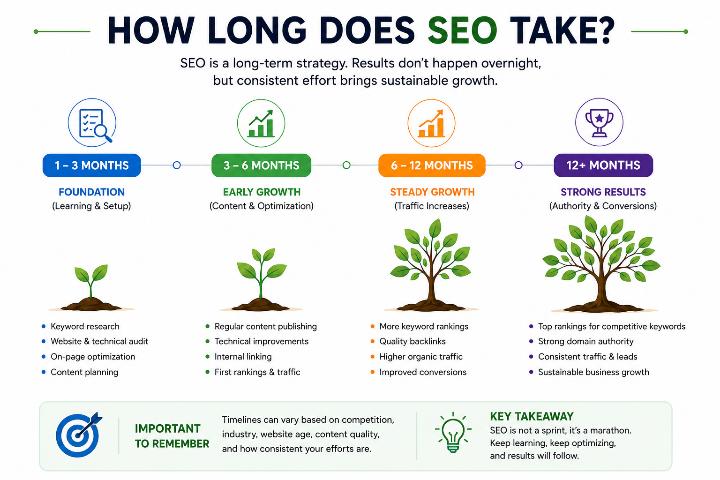
One of the most common questions that new SEO marketers ask is “how long does SEO take
to work?” The truth is that there is no standard answer to this question because all websites
are different. A new site with highly competitive keywords will obviously have a much harder
time compared to an older website with low competition. Some cases that affect how quickly
or slow SEO guide include:
- Age of the website
- Level of competition
- Difficulty of keywords
- Quality of content
- On-page optimization
- Backlink profile
- Website structure
- Necessity of ongoing SEO improvements
SEO is not a magic remedy that will instantly launch your site into the stratosphere of search
engine success. SEO guide optimization takes time and effort to slowly build up your
presence online. While there aren’t any shortcuts, there are ways to improve your rankings
and increase organic traffic through high-quality backlinks and relevant content in an SEO guide.
How to Measure SEO Performance
It’s vital to measure SEO results to ensure that your efforts give you the outcomes that you
need.
Below are the significant metrics that can be measured in due course:
Organic Traffic
This traffic source attracts website visitors through organic searches.
Keyword Rankings
The changes in one’s keyword rankings reflect the efficacy of one’s SEO campaign.
Click Through Rate (CTR)
When measuring one’s CTR, the metric helps the person concerned understand the
effectiveness of the title that they use on Google.
The Bottom Line On Measuring Outcomes Of SEO guide Essay
In addition to the metrics above, businesses, particularly the owners, can track conversions
that will offer more information needed on each step of their campaign. It is important to
note that the effectiveness of a given SEO team cannot be measured solely based on the
position of the page on the search engine results page.
Conversions attract the right traffic to a given business and are an excellent way of measuring
how well a certain company is doing in terms of SEO guide. There is no question that SEO
contributes immensely to business growth, though it should not be the main aspect
considered and measured when it comes to marketing.
Common SEO Mistakes to Avoid
Being overly concerned with keywords is a common mistake made by novices. These are a
some of the most typical SEO errors:
- Keyword stuffing
- Publishing low-quality content
- Buying cheap backlinks
- Disregarding mobile users
- Slow webpage
- Duplicate content
- Not considering search intent
- Not using internal links
- Not refreshing old content
- Expecting quick results
SEO is more about improving the general quality of your website than obsessing over
individual factors.
SEO Tools You Can Use
Several tools can make life easier when conducting SEO guide research and analysis.
Tools such as Google Search Console can help you track search performance and address
problems related to this area that your website’s presence in the Google search results may
have.
Another tool, Google Analytics, will help you analyze the traffic coming to the website and its
structure.
Keyword research and SEO tools that provide keyword suggestions and carry out various
types of analysis of competitors and backlinks and audit sites.
To start learning SEO, you do not need tens of different SEO tools. Become familiar with the
basic SEO tools and start learning how to work with the information they output in your SEO guide.
Final Thoughts
It may seem that SEO is a complicated endeavor to get acquainted with. However, its
fundamental concept is quite simple and is related to the provision of a website that is easily
readable by search engines and is beneficial for the target audience.
Therefore, the main steps to achieve this goal are keyword research, creation of beneficial
content, optimization of the website’s system, internal linking, and backlinks. Most
importantly, you should concentrate on the needs of your target audience.
Hence, the main point of SEO guide is not to attempt to guess the algorithm that will bring the
website to the first page of Google. Instead, it should be noted that the search engine’s
structure is constantly evolving, and so are people’s preferences.
Thus, a skilled SEO professional should not look for a magic bullet that will guarantee a high
position in the search results. Rather, he or she should be prepared to invest sufficient effort
and time in the process of gaining knowledge and learning new SEO guide strategies.
As a novice, one can use the present SEO guide and learn the basics of SEO. Additionally, a person
can conduct further study and read books, magazines, newspapers, and even websites about
the subject if they wish to understand more about it than what is currently covered in the
article. For example, keyword research, on-page optimization, technical SEO, local SEO,
content marketing, and backlinking are all available to anyone who are interested in studying
and applying SEO techniques.
Pingback: How Long Does SEO Take to Show Results? 7 Best Tips
Pingback: What Is SEO and Why Does It Matter? (2026 Guide)