A lot of newbie content creators make the same mistake when they start out: they pick a topic that interests them, write two thousand words, publish, and then go on. It doesn’t always work out. Mostly it doesn’t, and the content goes unnoticed because nobody actually looked for it.
This is where how to do keyword research for SEO comes in handy – and it’s not some arcane voodoo that only Google wizards can perform. How to do Keyword research for SEO is basically a process of finding out what queries your target audience is looking for online
This article is part of The Complete Guide to SEO: Everything You Need to Know, and similarly to other sections in the series, it focuses on a single topic: keyword research. In this article, I’ll explain what the concept is all about and why it’s important, give an overview of the process, and give you a few pointers on how to do keyword research for SEO to any site.
How to do Keyword research for SEO is a procedure encompassing the collection and analyzing of lexical and phraseological material, i. e., the terms and phrases that search engines look up. These words are the terms, which people are looking for while seeking information, goods, or services related to a certain topic.
The collected and analyzed data is further used to optimize the content and improve the visibility of the site. While it may seem like a complex undertaking at first glance, how to do keyword research for SEO is actually quite simple: it’s all about identifying the terms and phrases your target audience is actually using.
Researching keywords is (how to do Keyword Research for SEO) essential for SEO because:
- It makes your audience’s interests clear.
- What terms they use to search for information
- How tough a particular niche is to enter
- What pages you should prioritize
In short, keywords are the backbone of SEO strategy: by researching them (how to do Keyword Research for SEO), you gain valuable insight into your audience’s preferences and behaviors, uncover valuable information about the niche, and ensure your content provides answers to your audience’s questions. You can’t create content that people want if you don’t know what they want – and that’s the point of how to do keyword research for SEO.
Step 1: Begin with Your Company, Not a Tool
Most beginners start by opening a key phrase instrument (Keyword Research tool), looking into their search field, with a blank head. A better practice begins with a notebook or blank document. Write the following lines:
- The main products or services
- The problems that are solved
- The enquiries clients make via phone calls, emails, or direct messages
- The terms competitors are using on their sites
Let’s say your little business offers coffee makers. This is how your list might appear: The best manual coffee maker, espresso machine, beginner’s grinder, and how to descale a coffee maker. These are your seed keywords (the starting point of how to do Keyword Research for SEO). They may not be very good. It’s okay, they are just a starting point.
Additionally, you should consider the enquiries and questions that clients send to the customer support email. I notice that when people are looking for answers people often type the question into Google (a habit that how to do Keyword Research for SEO captures).
Step 2: Use Keyword Tools to Grow Your List
Getting your seeds to sprout is the next stage .To do that you will need these tools:
Google Keyword Planner. You need a Google Ads account to use it, but it’s free and helps you get an idea of your keyword’s potential and some rough volume estimations. Keep in mind that Keyword Planner is made for advertisers, so the numbers may be a bit underestimated.
Google autocomplete + “People Also Ask”. Just type your keyword in Google and hit enter. Examine the queries and recommendations that Google displays at the bottom of the natural search results. Then go to the “People Also Ask” section and study those questions. You can check what people are really looking for with this tool and you can also use this free tool to see the same.
Ahrefs, Semrush or Moz. one of the most widely used SEO tools by advertisers. They offer excellent how to do keyword research for SEO and competitor analysis options, although they can be quite expensive. If you’re a small business owner, you probably won’t use these often, but you’ll be surprised by the insights and statistics you can gather about your competitors’ sites.
Google Search Console. It may seem boring at first, but if you already have traffic on your website/blog, this is the best place to start. Google SC will show you queries based on which your site appears in Google results, even if you didn’t target them. And the easiest way to get more traffic is to take the queries ranking on position 11-12 and improve the relevant page to rank on position 1.
Google Trends. It’s perfect for understanding seasonality and overall trends (how to do Keyword Research for SEO). Using it, you can avoid creating content about something that only interests people for a short time.
These are the basic tools for how to do keyword research for SEO. You don’t have to use all of them – 2 or 3 will do. Learning the interface of the chosen tool is the important part. The interface of the chosen tool helps you get comfortable, with the data that the interface of the chosen tool gives you .
Step 3: Understand Search Intent
This is the stage that distinguishes excellent keyword research from poor how to do keyword research for SEO. I have seen many people get stuck at this point. Every search has a purpose. Google is very good at figuring out that reason. If your page does not match it you will not rank, no matter how well it is written.
There are four types of intent:
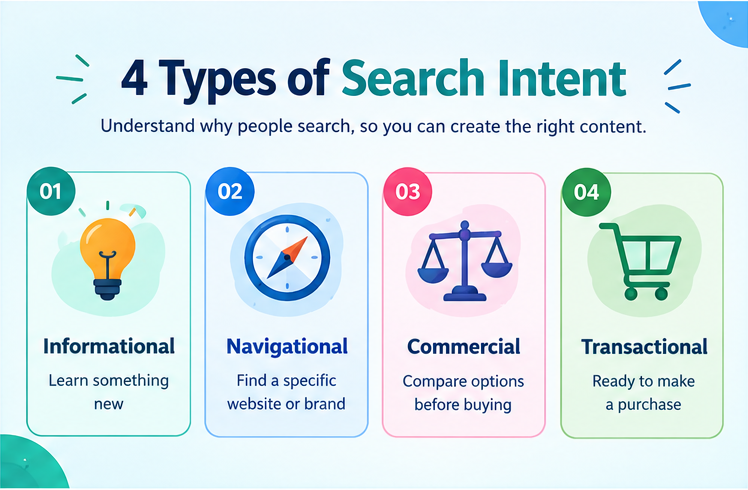
Informational
The person wants to learn something.For example: “how to clean an espresso machine.” I’ve seen a lot of folks ask that question.
Navigational
They are looking for a site or brand. For instance: “The Breville website.” I’ve observed folks entering that into the search bar.
Commercial
They are comparing options before buying. For instance, “espresso machines under $500.” I’ve noticed a lot of folks use this site to compare pricing.
Transactional
They are ready to buy. For instance, “buy Aeropress coffee maker.” I’ve seen individuals click that link.
A simple way to check intent is to search the how to do keyword Research for SEO yourself and look at page one. Are the results blog posts, product pages, videos or comparison lists? Whatever Google is rewarding is what your content needs to look like. I have found that matching the page type helps a lot.
Picture spending weeks on a guide, for a keyword that only shows product category pages. The guide never had a chance. A two-minute search would have saved all that effort. I have seen many people waste time on that.
Step 4: Check Search Volume and Keyword Difficulty
Once you have a list you must decide what to focus on because the list will help you choose the next step. Two numbers are useful here.
Search volume is basically how many times a keyword is searched every month. It shows if people are looking for something.
Keyword difficulty is the level of difficulty to reach the top of search results. Keyword difficulty varies across tools so do not depend on every tool. Think about every tool, as a recommendation but not a guarantee.
This is where people make a mistake: they look for the search numbers. A keyword with 50,000 searches a month sounds really good until you see that the top positions are taken by companies with lots of experience and trust.
If your website is new or small start with how to do keyword research for SEO that have search numbers and lower difficulty. A keyword that gets 300 searches a month and actually leads to sales is much better than a keyword, with 30,000 searches that you will never rank for.
Step 5: Go After Long-Tail Keywords
Longer and more focused phrases are known as long-tail keywords in how to do keyword research for SEO. Three or more words are frequently seen in long-tail keywords.
For example:
- Short-tail: “espresso machine”
- Long-tail: “best espresso machine for kitchen”

Long-tail keywords have a lower search volume, on their own but they bring real benefits:
- Less competition
- Clearer intent
- Higher conversion rates happen because the person searching has an idea of what they are looking for.
Many blogs increase their traffic through small long-tail wins rather than trying to get one major ranking. These small wins add up quickly than you might expect.
Step 6: Analyze Your Competitors
You don’t have to start from zero. See what others are doing well. Check out who’s showing up for how to do keyword research for SEO you want.
Put a competitor’s website into a tool, like Ahrefs or Semrush. Look at how to do keyword research for SEO they rank for. Watch for:
- Topics they write about that you haven’t touched
- Keywords where they rank on page two. Those are usually easier to beat
- How long and detailed their top pages are
This is called a keyword gap analysis. It’s one of the ways to find content ideas you wouldn’t think of on your own.
But here’s the real talk: don’t copy them. Use their work to see what’s working. Then create something. Make it clearer. Make it more helpful. Just don’t just copy.
Step 7: Group Keywords Into Topics
Here’s a shift that really helps: stop focusing on one keyword at a time and start thinking about topics instead.
Google gets it. It knows that “keyword research,” “how to do keyword research for seo ” and “keyword research for SEO beginners” are all talking about the thing. You don’t need a page for each one. Instead group similar keywords together and let one solid page cover the group.
That’s what this post is doing. It’s part of a cluster. Pieces that support a bigger main guide, on SEO. The main guide is the pillar page. It covers the picture. The cluster posts go into the details. When you link them together it helps both people and search engines see that your site actually knows the subject well.
A simple way to start? Put your keyword research for SEO in a spreadsheet. Sort them by theme. Each theme becomes a page or a whole pillar-and-cluster setup.
Step 8: Build Your Keyword Map and Content Plan
A list of keywords on its own is a list. To make it helpful turn it into a plan.
Make a spreadsheet with columns for:
- Primary keyword
- Secondary keywords
- Search intent
- Monthly search volume
- Difficulty
- The page or post it belongs to
- Status (planned, in progress published)
Assign one primary keyword to each page it is an important step in how to do keyword research for SEO. This is important because if two of your pages target the keyword they can end up competing with each other. This problem is called keyword cannibalization. When keyword cannibalization happens search engines may struggle to choose which page to display. I think that keyword cannibalization can be fixed by merging pages or by setting up redirects. This will help your website perform better. Fixing keyword cannibalization makes your content easier to read and stronger for visitors and, for search engines that visit your site which is matters when you learn how to do keyword research for SEO.

Common Keyword Research Mistakes to Avoid
These mistakes keep coming up over again.
- Ignoring intent is one. No matter how good your ranking is, if the page doesn’t match what the searcher is looking for it won’t help. Ranking is pointless if the content doesn’t answer the question.
- Another common error is focusing on volume. Big numbers look good on paper. High search volume often means high competition. You might end up fighting for a spot where it’s hard to win.
- Then there is keyword stuffing. When someone tries to pack keywords into material in order to appease search engines, this is known as keyword stuffing. Stuffing the text with how to do keyword research for SEO gives it an artificial sense. It hurts readability. Can even hurt your rankings. Make sure your term is appropriate for the context and sounds natural.
- Some people do the work once. Never look back. That’s a mistake. Search behavior changes. What worked years might not work today. Revisit your how to do keyword research for SEO every months to stay on track.
- Finally skipping the SERP check is a bad habit. Always check what’s already ranking for a keyword before you start writing. See what the top results offer. That helps you understand what the user really wants and how you can do better.
A Brief Example to Bring Everything Together
Let us say you write about home fitness. You begin with a seed how to do keyword research for SEO like “home workout” and “resistance bands.” Then you look at suggestions and see something like “home workout for beginners without equipment.” You check a keyword tool. Find that this phrase has good search volume and a moderate level of difficulty. Next you search for it. Look at the top results. You see they are mostly step-by-step guides with pictures. That tells you a how-, to article is the format. You go through the competitors. Notice that none of them have a 20-minute version. That’s your chance. That’s your gap. You can stand out by writing a 20-minute home workout guide.
That’s the process in a small example: start with a seed expand your ideas check what people are looking for judge how hard it will be find a gap and plan your content.
Final Thoughts
How to do Keyword research for SEO is not a Google game. It is listening. Every search is a person telling you what they need. It’s your job to supply the solution.
Don’t be afraid of the tools if you are new to it. Start with a notebook, a few tools, and a great deal of curiosity. Your first list will not be perfect. It is a start.
It’s essential to look at keywords before writing and rewriting as your site grows. Do that consistently. You will stop guessing and begin creating content that is actually found.
Want to go ? Return to [The Complete Guide to SEO: Everything You Need to Know] to see how to do keyword research for SEO fits with, on-page SEO, technical SEO and link building.
Frequently Asked Questions (FAQs)
What is keyword research for SEO?
It is the process of finding the words and phrases that your audience types, into search engines.
Do I need to pay for keyword research tools?
No. Free tools such, as Google Autocomplete, People Also Ask, Google Trends and Google Search Console are enough to get started.
What is search intent and why is it important?
The purpose of a search is the reason someone is looking for something. If the page you have doesn’t match what the person is looking for it probably won’t show up high in the results.
Should I target keywords with high search volume?
Not always. High-volume keywords often mean competition. So new websites tend to do with lower-volume easier keywords.
What are long-tail keywords?
Those are longer specific phrases that contain three or more words for example the phrase “best espresso machine for kitchen.” The phrase ” espresso machine, for kitchen” faces less competition and shows a clearer intent.
How often should I revisit my keyword research?
Every months you should look at your list. Search behavior changes. Refreshing your list keeps your content relevant. Search behavior changes again.
Pingback: 7-Step Ultimate SEO Guide: Everything You Need to Know